What made Cologne a Design City?
by Robin H.
Welcoming the World - Seven decades of design & hospitality
For more than seven decades, Cologne has welcomed the international design world. A story shaped by furniture and experimentation, legendary exhibitions and new ideas — but above all by a city that knows how to bring people together.
Cologne's rise as an international design destination began at a moment when optimism itself was an act of imagination.
In 1945, large parts of the city lay in ruins. The centre had been devastated, hundreds of thousands of people had left or been displaced, homes had disappeared and everyday life had to be built again almost from the ground up. And yet, remarkably quickly, Cologne began looking forward.
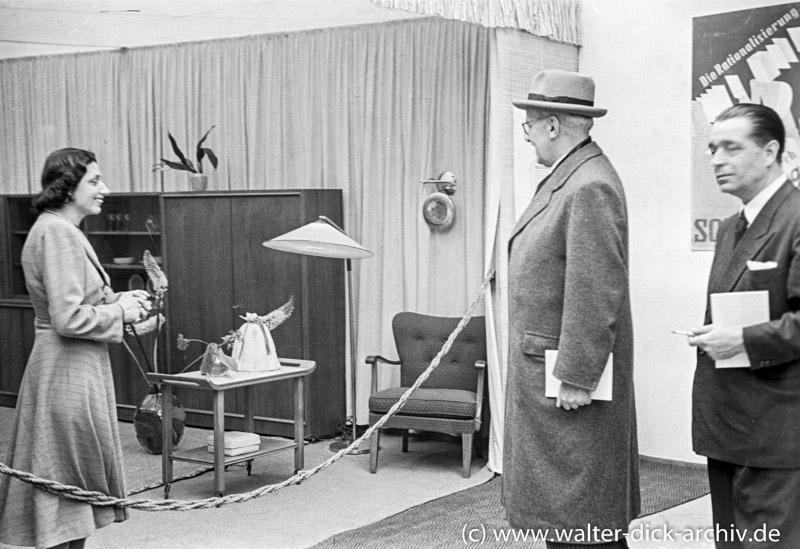
In the spring of 1949, the first post-war Cologne Furniture Fair opened its doors. There was a country to rebuild, homes to furnish and a society beginning to imagine what modern life might look like after years of destruction. Furniture suddenly meant more than furniture: it was part of creating everyday life again.
From these beginnings grew one of the world's great meeting places for interiors. Year after year, the fair brought designers, manufacturers, architects, journalists and buyers to the Rhine. January became Cologne's design month. Winter coats filled the streets, taxis moved between the fairgrounds and the city, restaurants stayed busy late into the evening and conversations continued long after the exhibition halls had closed. The Rhine might have been silver-grey and the air decidedly crisp, but inside Cologne there was warmth, energy and the feeling that this was where the international design community came together to start the year.
Over time, Cologne developed a particular talent for giving design room to become something more than a product presentation. One of its most extraordinary chapters began with VISIONA. Between 1968 and 1972, an excursion boat on the Rhine was transformed into an experimental landscape for ideas about the future of living. Verner Panton, Joe Colombo and Olivier Mourgue were among the designers invited to create immersive environments that blurred the boundaries between furniture, interiors, colour, light and architecture.
With Panton's legendary Fantasy Landscape in 1970, visitors entered an almost otherworldly interior of organic forms and intense colour. It was radical, playful and optimistic. An expression of a time fascinated by how differently we might live tomorrow. And its setting could hardly have been more Cologne: while the international furniture industry gathered at the fair, some of its boldest visions were quite literally floating past the city on the Rhine.
That appetite for experimentation continued to grow beyond the exhibition grounds. In the 1990s, PASSAGEN became a particularly vivid chapter. International manufacturers increasingly understood that Cologne offered another kind of stage beyond the conventional stand. Cappellini brought its universe to the city in a major retrospective curated by Achille Castiglioni, while names that would define the coming decades moved through exhibitions, installations and presentations: from Giulio Cappellini and Jasper Morrison to Marcel Wanders.
By the turn of the millennium, old industrial buildings in Deutz, temporary spaces around the Rheinauhafen and unexpected locations across the city had become stages for an increasingly international design culture.
For one week, Cologne became a city to discover.
You could spend the day seeing the newest furniture at the fair and find yourself that evening inside an unexpected building somewhere across the Rhine. A presentation led to a dinner, a dinner to a party, and a party to the kind of conversation that might become a collaboration a year later. Design travelled through the city, and with it travelled thousands of people.
Perhaps this is where Cologne's role in design history becomes particularly interesting. Its success was shaped by the important exhibitions and institutions it created, but equally by the culture surrounding them.
Cologne became a host to design.
There is a warmth to the city that generations of visitors have experienced. An openness that makes introductions easy and encounters informal. The famous Cologne conviviality “Kölsche Geselligkeit” found a natural counterpart in an international design scene built around exchange. A Kölsch at the bar could put a student next to an internationally known designer, a manufacturer next to an architect, a local creative next to someone who had flown in from Milan, London, New York or Tokyo.
This mixture became part of the Cologne experience: international ambition paired with local warmth, serious design accompanied by a sense of fun, professional exchange turning naturally into personal connection.
And perhaps that explains why people kept returning even in the worst weather imaginable.
Each generation added another layer to the city's design story.
And then, somewhere along the way, the rhythm changed.
The pandemic accelerated a transformation already underway in the international design industry. Markets shifted, travel changed and established formats began asking themselves difficult questions about their future. Cologne felt that transition particularly strongly. The imm cologne paused in 2025, and Koelnmesse subsequently reorganised its interiors portfolio around new and more specialised formats.
That period has left its mark on the way Cologne is discussed today. There is disappointment. There is criticism. There are people who remember packed January nights, extraordinary installations and an international scene that once seemed to descend on the city almost automatically and who ask whether Cologne can still occupy that position in a design world that has moved on.
It is a fair question because history alone doesn't make a design city. A famous past is no substitute for new ideas, new energy or the willingness to change.
But perhaps Cologne's history offers another way of looking at the question.
The Cologne of 1949 wasn't building on certainty. The VISIONA years weren't interesting because they repeated what had come before. PASSAGEN didn't become exciting by keeping design where everybody expected to find it. Again and again, the moments we remember most fondly were moments in which Cologne opened itself to something new.
Reinvention is part of history, too. And that changes the conversation.
Instead of asking whether Cologne deserves a place in the international design world because it once had one, perhaps the more interesting question is what this city could create next.
The ingredients that made its best moments possible were always bigger than a single format. They were the people who opened doors. The manufacturers willing to experiment. The designers taking over unexpected spaces. The galleries, institutions, bars, restaurants and neighbourhoods that became part of the experience. And a city whose particular openness made thousands of international visitors feel surprisingly at home.
Cologne has spent more than seventy years showing that design can be an industry, an experiment, a conversation, a night out, a new friendship and sometimes a glimpse of the future — all within the same few days.
Remembering that history shouldn't mean looking backwards through the golden light of nostalgia — it can give us the confidence to look forward.
Because a city that has created this kind of energy before already knows something about bringing people together. And perhaps, at a moment when so much of the design world itself is changing, that ability to welcome people, ideas and different perspectives is more valuable than ever.
Cologne has been a remarkable host to design for generations. And its history gives us every reason to look forward to what comes next.
Photo Source: Kölner Werkbundausstellung, Messe Köln, 1949 — “Neues Wohnen”: Korbmöbel für Haus und Garten. Photo: Walter-Dick-Archiv Köln
U.S. Department of Defense / U.S. Army on 24 April 1945 / held by the U.S. National Archives.